


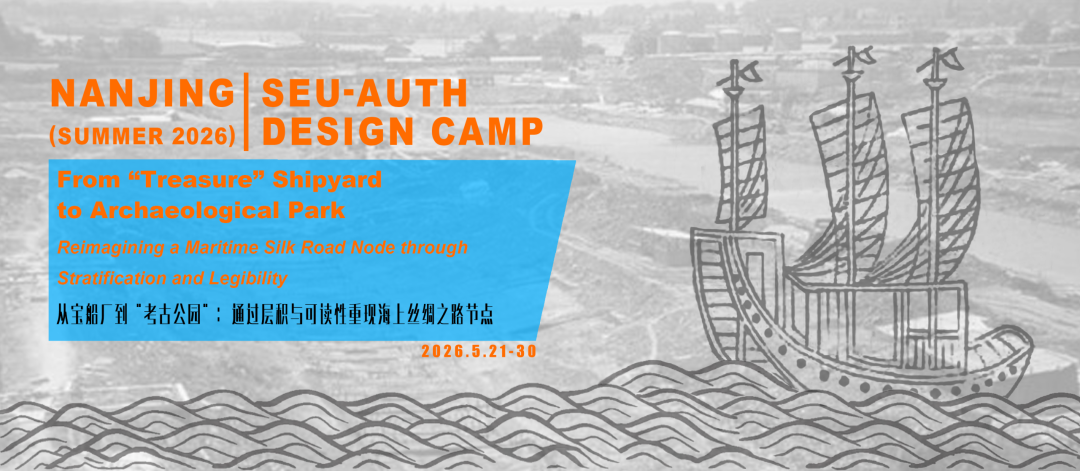
2026东南大学-亚里士多德大学联合设计营|从宝船厂到“考古公园”:通过层积与可读性重现海上丝绸之路节点
SEU-AUTH Design Camp in Nanjing (Summer 2026)|From “Treasure” Shipyard to Archaeological Park: Reimagining a Maritime Silk Road Node through Stratification and Legibility
主办单位:东南大学建筑国际化示范学院/太阳集团tyc122cc、亚里士多德大学太阳集团tyc122cc
由东南大学建筑国际化示范学院/太阳集团tyc122cc与希腊亚里士多德大学太阳集团tyc122cc联合举办的“2026东南大学—亚里士多德大学暑期国际设计工作营”将于2026年5月21日至30日在南京举行。
亚里士多德大学位于希腊第二大城市塞萨洛尼基,是希腊规模最大、最具国际影响力的大学之一,在建筑、历史遗产、城市与地中海文化研究等领域具有重要学术地位,其太阳集团tyc122cc长期活跃于欧洲建筑教育与文化遗产研究网络。
本次设计营延续去年在希腊塞萨洛尼基举办的联合工作营,将沿着古代海上丝绸之路逆向溯源,汇聚于南京宝船厂遗址——海上丝绸之路的东方起点,旨在进一步深化两校之间的国际教学与学术合作。设计营以“从宝船厂到‘考古公园’:通过层积与可读性重现海上丝绸之路节点”为主题,将围绕历史遗址与当代城市生活之间的关系展开,探索如何通过建筑、景观与空间设计重新激活场地中被遮蔽的历史信息与文化层积。
此次设计工作营与由东南大学与亚里士多德大学共同主办的国际学术会议“欧亚的根脉与通途:文化与文明的迁移与转化”同期举行。希腊驻华大使、阿卡汗建筑奖主席,以及多位来自国际知名高校与研究机构的建筑学者与文化研究专家将出席本次会议并作报告。作为设计营的重要学术支持,设计营成员将参与会议相关活动,从而近距离参与国际学术交流,了解建筑、遗产与跨文化研究的前沿讨论。
除国际会议活动外,工作营还将邀请南京市文物局的专家与任课教师一道,专门安排面向设计与文化遗产议题的专题讲座、讨论与评图,以进一步提升同学们的设计研究能力与国际交流经验。
The “2026 Southeast University–Aristotle University International Summer Design Camp” jointly organized by the School of Architecture and the Demonstration College for Internationalization of Architecture at Southeast University and the School of Architecture at Aristotle University in Greece, will be held in Nanjing from May 21 to 30, 2026.
Aristotle University, located in Thessaloniki—the second-largest city in Greece—is one of the largest and most internationally influential universities in the country. It holds a significant academic standing in fields such as architecture, heritage studies, urban research, and Mediterranean culture. Its Faculty of Architecture has long been active within European networks for architectural education and cultural heritage research.
This design camp continues last year's joint design camp held in Thessaloniki, Greece, tracing the ancient Maritime Silk Road backward to converge at the Nanjing Baochuan Shipyard site—the eastern starting point of the Maritime Silk Road—aiming to further deepen international teaching and academic collaboration between the two universities. Centered on the theme “From Treasure Shipyard to Archaeological Park: Reimagining a Maritime Silk Road Node through Stratification and Legibility” the camp will explore the relationship between historical sites and contemporary urban life, investigating how architectural, landscape, and spatial design can reawaken the obscured historical narratives and cultural strata embedded within the site.
This design camp coincides with the international academic conference “Roots Within and Routes Across Eurasia: migrations and transformations of cultures and civilizations”, jointly hosted by Southeast University and Aristotle University. The Greek Ambassador to China, the President of the Aga Khan Award for Architecture, along with numerous architectural scholars and cultural studies experts from renowned international universities and research institutions, will attend the conference and deliver presentations. As a key academic partner, participants in the design camp will take part in related conference activities, enabling them to closely engage in international scholarly exchange and gain insights into cutting-edge discussions on architecture, heritage, and cross-cultural research.
In addition to international conference activities, the design camp will also invite experts from Nanjing Municipal Cultural Heritage Bureau to join the teaching faculty in organizing specialized lectures, discussions, and design reviews focused on design and cultural heritage topics, further enhancing students' design research capabilities and international exchange experience.
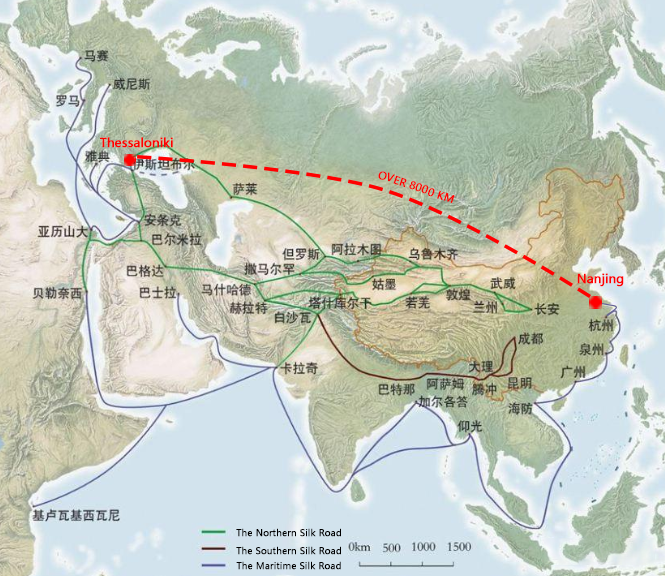
陆上丝绸之路与海上丝绸之路路线示意图
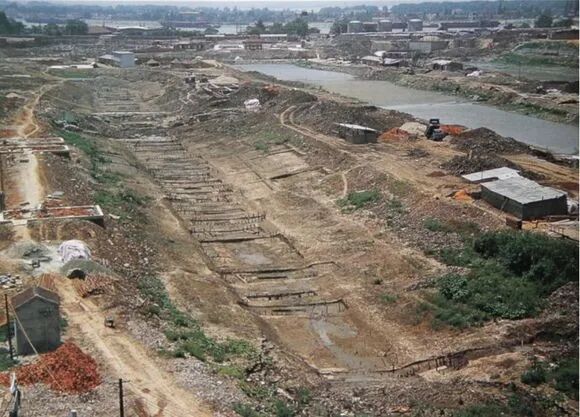
六作塘发掘完成后全景(自东向西)
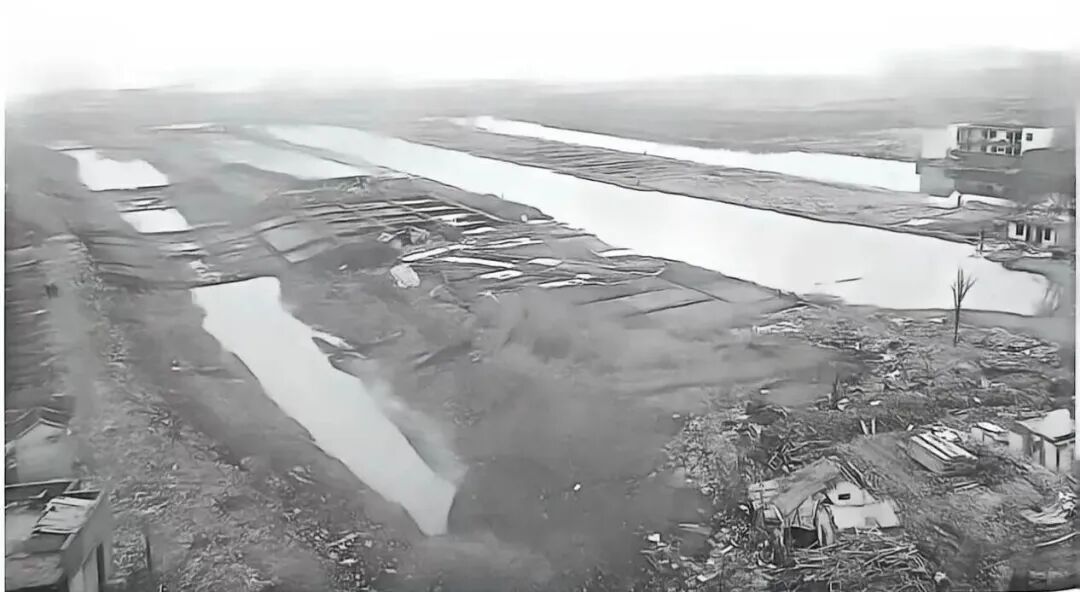
遗址布方情况(自东向西)
主题概述:从宝船厂到“考古公园”:通过层积与可读性重现海上丝绸之路节点
来自两校的学生将组成混合小组,围绕南京宝船厂遗址开展设计研究。该场地毗邻长江,位于南京高密度城市核心的边缘。
在明代,郑和下西洋的船队正是在此建造,并由此启航,通往西亚与非洲,开辟了著名的海上丝绸之路。十四世纪末至十五世纪初,南京正是这些航行的重要出发地。不同于许多以征服为目的的海上活动,这些远航更侧重于外交、贸易与文化互动。宝船所载之物包括丝绸、瓷器、玉器等珍贵货物,归航时则带回象牙及其他异域资源,“宝船”之名及“宝船厂”的称谓,均来源于此。
如今,该场地已转变为向公众开放的城市公园,兼具历史记忆、公共教育、旅游与日常休闲等多重功能。然而,其现状亦呈现出一种张力:当代功能与景观层层叠加,在丰富体验的同时,也削弱了场地历史意义的可读性,使其难以清晰传达自身的历史信息。
本工作营以“考古公园”为切入点,对这一问题展开探讨。在此,“考古”并非指向对遗址的发掘或复原,而是一种方法性的设计视角——通过揭示、重组并强化场地中历史、空间与文化的多重层积,使其在当代语境中重新获得可读性。在这一意义上,设计的目标既不是将场地复原至某一历史状态,也不是赋予其全新形象,而是通过重释其不同时间层的关系,使其能够在当代城市生活中被感知、被理解并被使用。
Mixed groups of students from both schools will develop design proposals for the Treasure Shipyard site in Nanjing, located at the threshold between the dense urban core and the Yangtze River.
During the Ming Dynasty, the fleets of Zheng He were constructed here for voyages across the Maritime Silk Road to West Asia and Africa. For these expeditions, Nanjing served as a principal departure point in the late fourteenth century and early fifteenth centuries. Unlike many contemporary maritime enterprises, these voyages were conceived less as campaigns of conquest than as missions of diplomatic exchange, trade, and cultural encounter. The ships built at the Nanjing shipyard – known as “treasure ships” – were accordingly laden with valuable goods such as silk, porcelain, and jade for outbound journeys, and returned with materials including ivory and other commodities from distant regions. It is from this practice of transporting precious cargo that both the designation of the vessels as “treasure ships” and the naming of the shipyard itself are derived.
Today the site functions simultaneously as a place of historical memory, public education, tourism, and everyday recreation, having been transformed into an urban park accessible to visitors and the local residents. Yet its current condition reveals a tension: layers of contemporary programming risk obscuring the legibility of its historical significance. What appears as enrichment may, in fact, diminish the capacity of the site to communicate its own past.
The design camp approaches this condition through the notion of the “archaeological park.” Here, the term archaeological is not understood in a strictly literal sense of excavation or preservation. Rather, it is used metaphorically—as a mode of design inquiry that seeks to reveal, reorder, and render legible the layered historical, spatial, and cultural strata embedded within the site. In this sense, the project is not to return the site to a prior state, nor to impose a new image upon it, but to rearticulate its multiple temporal layers so that they may be perceived, interpreted, and inhabited within contemporary urban life.
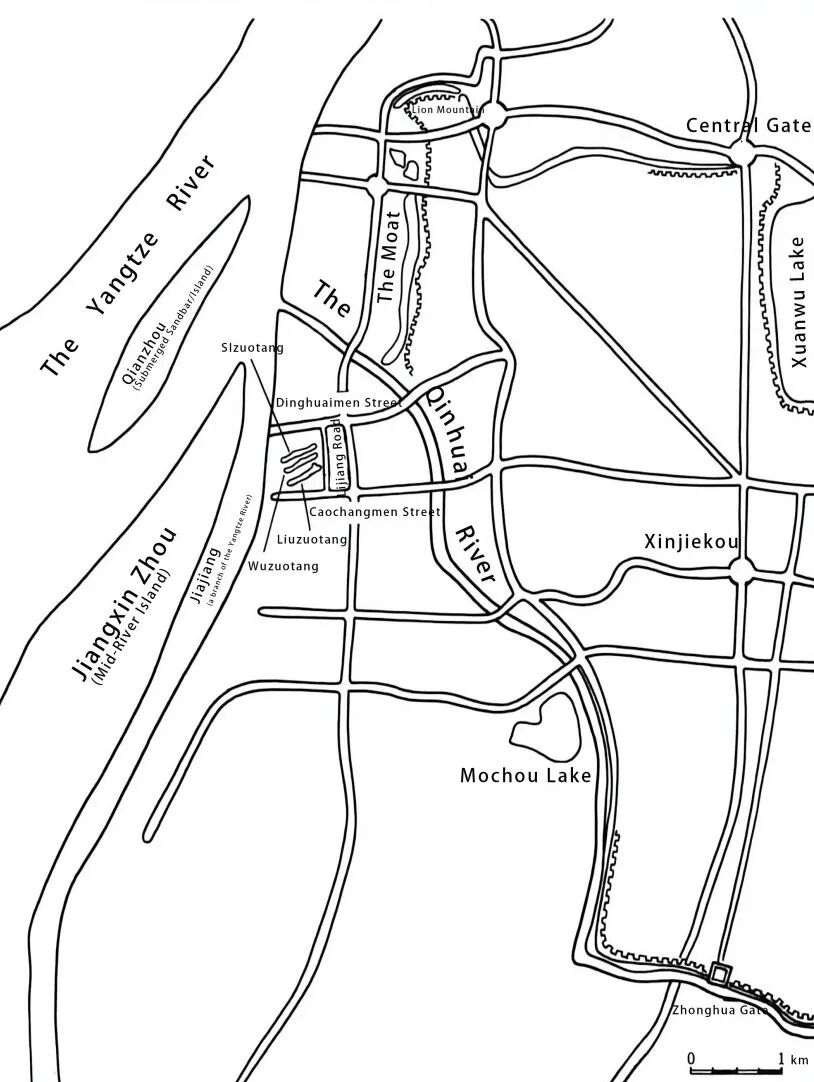
南京宝船厂遗址位置图
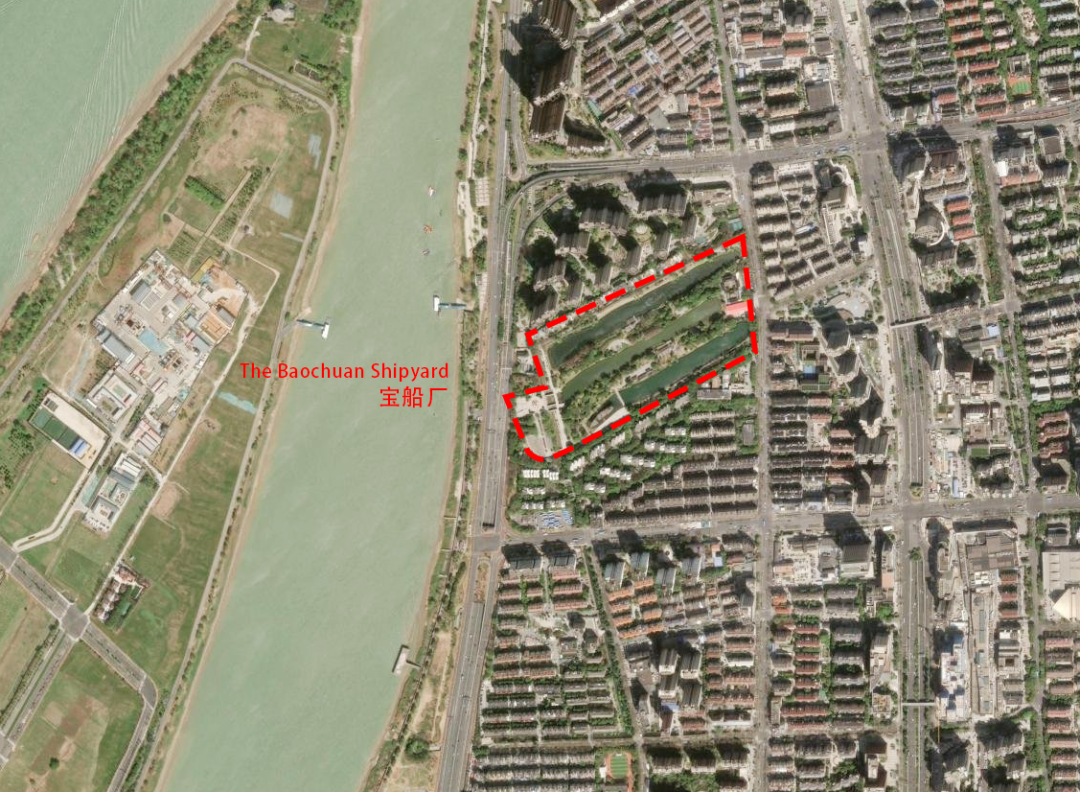
宝船厂遗址卫星图
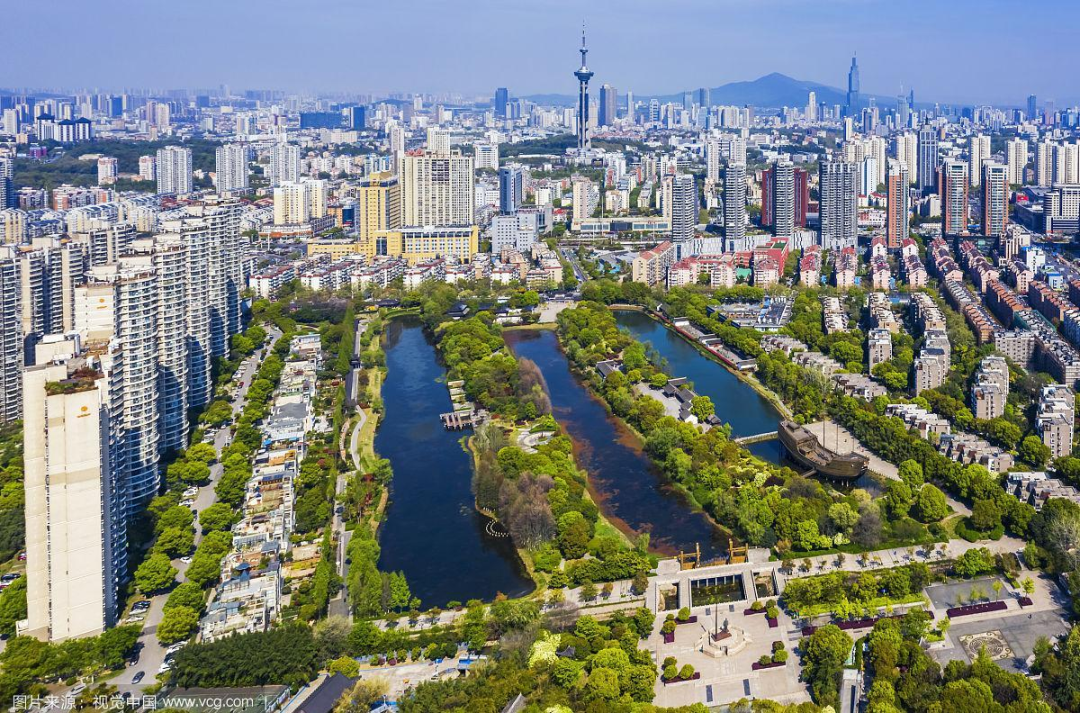
南京宝船厂现状鸟瞰图
教学目标
本次联合设计营以宝船厂为田野现场,围绕“考古公园”这一核心命题,通过国际联合教学,旨在提升建筑设计思维能力,培养青年人才,并深化对文化遗产的理解,尤其是它如何可以作为一种动态且具有生成性的条件,来参与当代设计与生活。
设计将围绕以下四个相互关联的尺度与主题展开:
地域尺度(Territory):通过重新建立或再现宝船厂与长江之间的历史联系,来恢复其历史—地理信息,同时也要面向现代生活来重构其与周边城市的关系;
景观尺度(Landscape):通过重组路径系统、空间序列与层级关系,对场地空间进行再阅读,以提升其整体可读性;
建筑尺度(Architecture):通过设计展示历史文物与信息的亭馆等小型建筑,既展示也阐释历史遗物,同时为使用者提供必要的空间庇护;
材料与建构(Materiality):通过对材料与构造细部的探索,来表达“层积”的历史信息,而不仅停留于技术层面。
此外,工作营还将组织参访南京其他与本课题有密切关系且具有重要历史文化意义的地点,如明故宫遗址及相关寺庙等,以丰富设计研究的背景。
This joint design studio takes the Baochuan Shipyard as its field site, centering on the "archaeological park" as its core proposition. Through international collaborative teaching, it aims to sharpen architectural design thinking, nurture young talent, and deepen understanding of cultural heritage—especially how it can serve as a dynamic, generative condition that actively participates in contemporary design and everyday life.
Design interventions will be developed across four interrelated scales and themes:
a. Territory: Recovering the historical-geographical layers by re-establishing or re-presenting the historical connection between the site and Yangtze River. The interface between the site and the surrounding city also needs to redefined;
b. Landscape: Re-reading spatial sequences by reconfiguring paths, sequences, and spatial hierarches to enhance legibility;
c. Architecture: Mediating between artifact and interpretation by designing pavilion(s) for the display of historical artifacts and related information, which also provide shelter for visitors;
d. Materiality: Expressing stratification by exploring construction details beyond mere technical solutions.
In addition, visits to other historically and culturally relevant sites in Nanjing, including the Ming Imperial Palace and some temples, will complement the design work.
教学团队
指导教师:David Leatherbarrow(东南大学)、史永高(东南大学)、李新建(东南大学)、Esra Şahin Burat(东南大学)、Antonios Thodis(东南大学)、Anastasios Tellios(AUTH)、Alkmini Paka(AUTH)、Dimitrios Thomopoulos(AUTH)
特邀评图/讲座嘉宾:张旭(东南大学)、Despoina Zavraka(AUTH)
助教:程轩(东南大学)、Rodi Tsitouridou(AUTH)
Instructors: David Leatherbarrow (SEU), SHI Yonggao (SEU), LI Xinjian (SEU), Esra Şahin Burat (SEU), Antonios Thodis (SEU), Anastasios Tellios (AUTH), Alkmini Paka (AUTH), Dimitrios Thomopoulos (AUTH)
Invited critic/lecturer: ZHANG Xu (SEU), Despoina Zavraka (AUTH)
Teaching Assistants: CHENG Xuan (SEU), Rodi Tsitouridou (AUTH)
信息来源:亚洲建筑档案中心
审核:朱渊、周文竹
